
How to fix a dripping tap
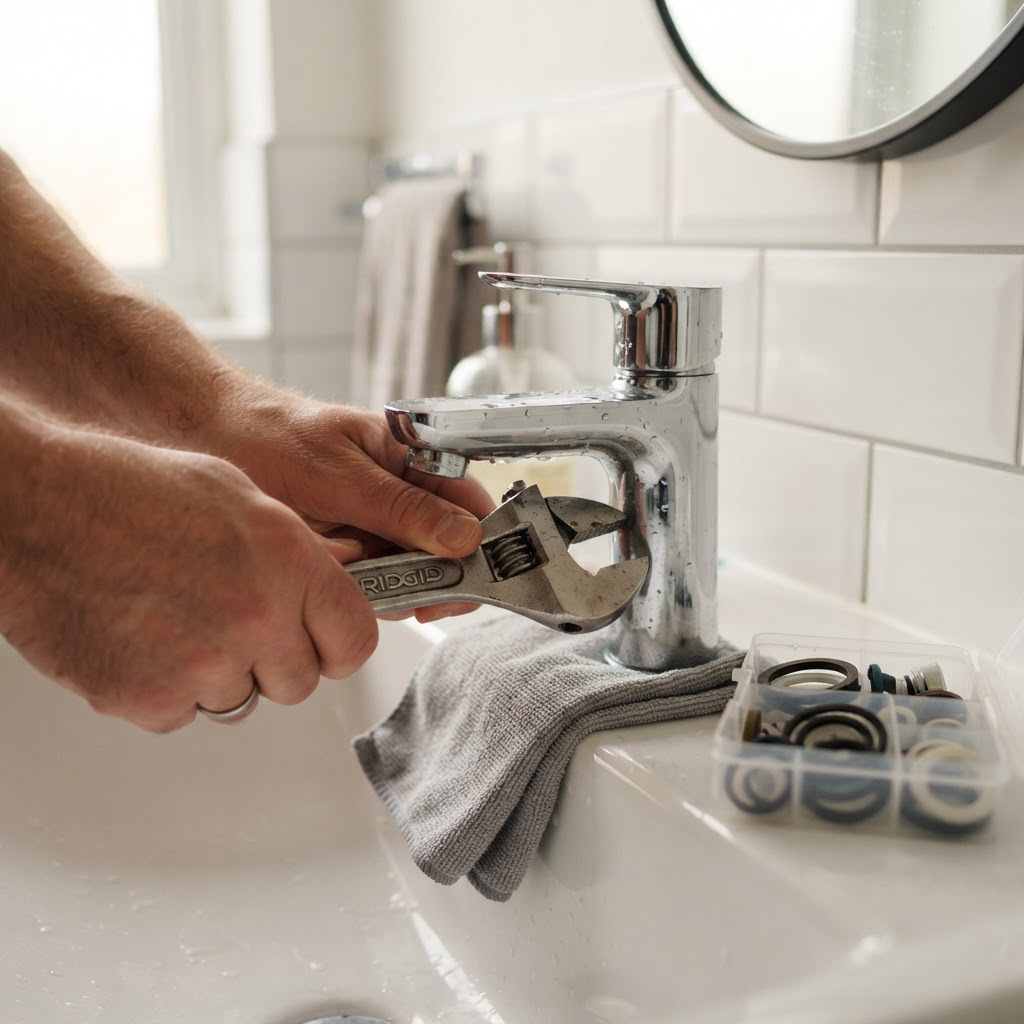
Dripping taps waste water and mark the basin, and most are a washer or a ceramic cartridge rather than a new tap. Take the old part with you when you buy the replacement, as sizes vary more than people expect. If the tap will not come apart, or there are no isolation valves and the stopcock will not close, it is worth stopping rather than forcing it.
What you will need
- Adjustable spanner
- Flat-head screwdriver
- Set of Allen keys
- Small bowl and cloth
- Silicone grease
What to buy
- Replacement washer or ceramic cartridge to match the tap
- PTFE tape
Step by step
Identify the tap
A quarter-turn handle usually means a ceramic cartridge. A handle that turns a half or full circle is normally a traditional tap with a rubber washer on a jumper valve. Buy the matching part before taking anything apart.
Turn the water off
Close the isolation valves under the basin or bath if there are any, then open the tap to drain what is left in the pipe. If there are no valves, close the main stopcock and open the cold tap at the kitchen sink to prove the water is off.
Take the handle off
Prise off the index cap on top of the handle and undo the screw underneath, then lift the handle away. Keep the screw somewhere safe: it is the part most often lost.
Remove the valve or cartridge
Use the spanner on the flats of the valve body, not on the pipework. On a cartridge tap, unscrew the retaining ring by hand or with the spanner and pull the cartridge straight out.
Fit the replacement
Smear a little silicone grease on the new washer or the cartridge O-rings, seat it squarely, and reassemble in the reverse order. Do not overtighten the valve body: firm is enough, and forcing it can split the seat.
Test it
Turn the water back on slowly and check for weeping around the base of the tap as well as at the spout. Run it hot and cold for a minute, then dry everything and look again.
Where people go wrong
- Buying a washer without taking the old one to match
- Not proving the water is off before undoing anything
- Overtightening the valve and splitting the tap seat
- Losing the handle screw down the plughole
- Forgetting to check the base of the tap as well as the spout
Safety, and when to stop
Water and electricity do not mix: if the tap is near a socket or the leak has reached wiring, turn the electrics off and call someone. Never force a seized valve, as it can shear and leave you with water you cannot stop. If the tap is more than fifteen years old and the seat is worn, a new tap is often cheaper than the parts.
Questions
How much does the part cost?
A rubber washer is usually a pound or two. A ceramic cartridge is more, typically eight to twenty pounds depending on the tap, which is still far less than a replacement tap and fitting.
When is it better to replace the tap?
When the body is corroded, the handle is loose on the spline, or the seat inside is pitted. Replacing the cartridge will not fix a worn seat, and it will start dripping again.
It still drips after the repair. Why?
Usually the wrong size washer, grit trapped on the seat, or a cartridge that is not seated squarely. Take it apart, clean the seat, and check the part number against the tap.
Rather not tackle it?
This is the sort of job Townsley Multi Services does every week around Wetherby and York. Send a photo and we will tell you what it needs.