
How to hang a bathroom mirror
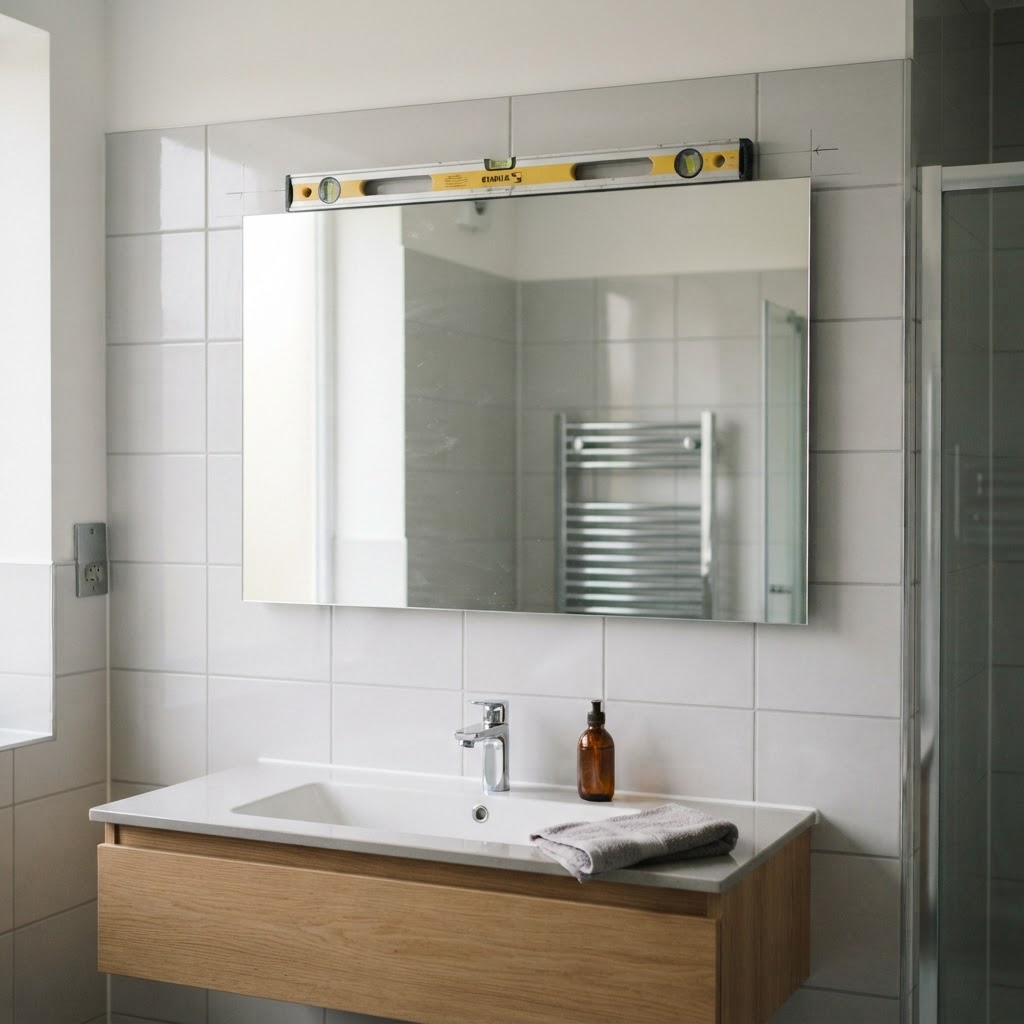
Hanging a mirror is quick, but a bathroom is one of the more awkward places to drill: the walls are tiled, the pipes run behind them, and the mirror is usually heavier than it looks. The job is straightforward once you know what is behind the wall and have picked a fixing rated for the mirror's weight. Set the height properly first, because a mirror that is 100mm too high is something you will notice every morning.
What you will need
- Tape measure, pencil and masking tape
- Spirit level
- Pipe and cable detector
- Drill with a tile bit and a masonry bit
- Screwdriver and a small adjustable spanner
- Vacuum or a cloth for the drilling dust
- Sealant cartridge gun if the mirror sits in a wet area
- Step stool or a second pair of hands for a large mirror
What to buy
- The mirror, with its fixings or hanging plates
- Wall plugs and screws rated well above the mirror's weight
- Silicone or mirror adhesive if the mirror is being bonded rather than hung
- A few self-adhesive felt pads for the back of a frameless mirror
Step by step
Work out the height before you mark anything
The usual rule is the centre of the mirror at eye level, which for most people is around 1.6m from the floor. In a bathroom, work from the basin instead: leave about 200 to 250mm between the top of the basin or tap and the bottom of the mirror, so you can see your face without stooping and the mirror clears the tap when it is turned. Hold the mirror against the wall with tape, or get someone to hold it, and stand back before you commit.
Check what is behind the wall
Run a pipe and cable detector over the whole area the mirror and its fixings will cover, not just the two hole positions. Above a basin there is almost always a hot and a cold pipe rising to the tap, and often a lighting cable. Mark anything it finds with pencil and keep every fixing at least 150mm clear of it. If the detector gives a reading you cannot account for, stop and trace it before drilling.
Choose a fixing that suits the wall and the weight
On solid tile over blockwork or brick, a standard screw into a brown or blue plug is fine for a mirror up to around 10kg. On tile over plasterboard, use a hollow-wall fixing rated for the load, or find the studs and fix into those. Weigh the mirror, then pick fixings rated at two or three times that: a mirror above a basin gets knocked, and the fixing takes the shock. For anything over about 15kg, or a mirror wider than 900mm, use two people and fix into the studs or solid wall.
Mark and drill the holes
Measure the fixing centres on the back of the mirror and transfer them to the wall, checking with the level across both marks and down the mirror's edge. Put a strip of masking tape over each spot so the drill bit does not skate across the glaze. Drill slowly on a low speed with a tile bit until you are through the glaze, then switch to a masonry bit and drill to the depth of the plug. Hold the vacuum nozzle beside the bit as you go, and wipe the dust off before anything is fitted.
Fit the plugs and hang the mirror
Tap the plugs in flush with the tile face, not proud of it, and screw the hanging plates or brackets on. Lift the mirror onto its fixings and check the level across the top and down one side. If it is out, take it down and slot the holes slightly rather than forcing it: a mirror hung under tension will crack at the screw hole. On a frameless mirror, fit the felt pads at the bottom so it stands off the tiles and air can move behind it.
Seal the edges if it sits in a wet area
If the mirror is close to a shower or a bath, run a thin bead of anti-mould silicone around the edge, or fit a sealing strip. Water gets behind an unsealed mirror and the silvering fails from the edge inwards, which cannot be repaired. Smooth the bead once, wipe the tiles clean, and leave it alone to cure.
Where people go wrong
- Drilling without checking for pipes and cables first
- Choosing fixings rated for less than the weight of the mirror
- Hanging the mirror so high that the bottom cuts off your chin
- Drilling into tile at full speed, which cracks the glaze
- Forcing a mirror level after drilling, which stresses the glass at the screw holes
- Leaving a mirror unsealed next to a shower, so the silvering fails at the edges
- Using adhesive alone on a mirror too heavy for it, or on a wall that is not flat
Safety, and when to stop
Bathrooms have strict rules about electrical equipment, and a mirror with a built-in light or shaver socket must be fitted by a qualified electrician, in the correct zone for its distance from the bath or shower. Never drill blind above a basin or a bath: pipes and cables sit close to the surface. A large mirror is heavy and awkward, so use two people rather than balancing it on a basin, and always check that the wall you are fixing to is sound and not hollow or crumbly.
Questions
What height should a bathroom mirror be?
Centre it at roughly eye level, about 1.6m from the floor, or leave 200 to 250mm between the tap and the bottom of the mirror. Working from the basin rather than the floor is more reliable in a room where the basin height varies.
How do I drill through tiles without cracking them?
Use a tile bit on a slow speed with no hammer action, keep the bit wet, and put masking tape over the spot so it does not skate. Once through the glaze, swap to a masonry bit for the wall behind.
Can I glue a mirror to the wall instead of drilling?
Yes for a small, light mirror on a flat, sound wall, using a proper mirror adhesive that does not attack the backing. It is not a good idea in a bathroom: you cannot remove the mirror without breaking it, and the wall behind cannot dry out.
Do I need a special mirror for a bathroom?
A safety-backed mirror is the sensible choice anywhere it could be knocked, and it is what most bathroom mirrors are. Copper-free backing also lasts much longer in a steamy room.
How do I find pipes behind a tiled wall?
A pipe and cable detector swept over the whole area, plus a bit of logic: pipes rise straight up to the tap and usually run in line with it. Marks on the wall from old fittings, or a boiler on the other side, give it away too.
What if the mirror will not sit level?
Take it down and file or re-drill the fixing slot slightly rather than tightening it level. A mirror held under tension cracks at the screw hole, usually months later when the weather changes.
Rather not tackle it?
This is the sort of job Townsley Multi Services does every week around Wetherby and York. Send a photo and we will tell you what it needs.