
How to hang an internal door
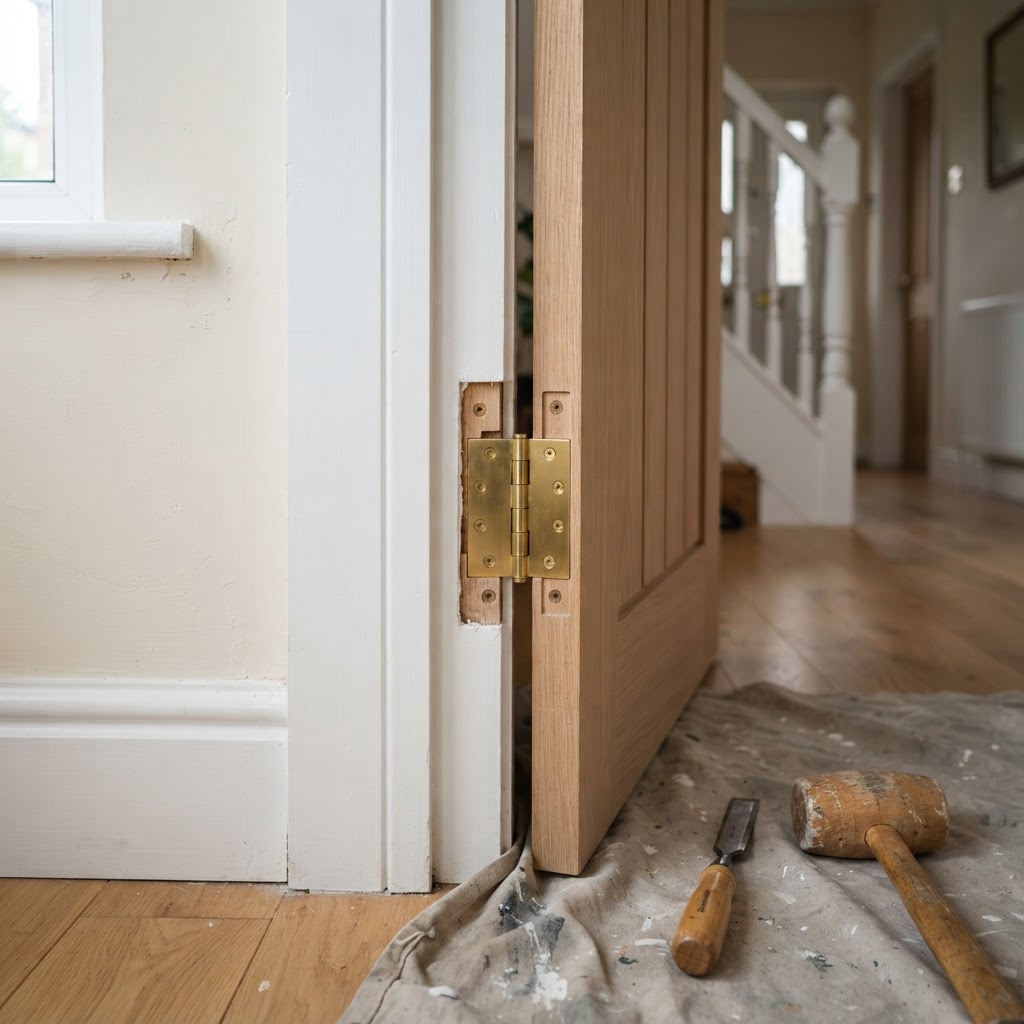
Hanging a door is fiddly rather than difficult. The door has to sit in the frame with an even gap all round, clear the floor, and swing without binding. Most of the work is measuring and taking small amounts off, so it is a good job for a confident DIYer with a decent plane or a door-trimming guide. If the frame itself is twisted or out of plumb, fix the frame first, because no amount of planing will make a door close in a crooked opening.
What you will need
- Tape measure, pencil and marking gauge
- Spirit level and a long straight edge
- Plane or door-trimming jig with a circular saw
- Chisels, 10mm and 25mm
- Mallet
- Cordless drill and bit set
- Screwdriver
- Sanding block and wedge
What to buy
- The door
- Three hinges (or the number the door came with)
- Matching screws
- Wood filler and a pack of spacers or wedges
- Masking tape
Step by step
Check the frame and the opening
Measure the opening at the top, middle and bottom, and check both sides with a level. A frame that is out of square by more than a few millimetres will need packing or replacing before the door goes on. Measure the smallest dimension and trim the door to that, not to the largest.
Trim the door to fit
Take 3mm off each side and about 5mm off the top as a starting allowance, then offer the door up. Keep the gaps even, roughly 2 to 3mm at the sides and top. Take a little off at a time and re-check, because a door that is planed too small cannot be put back. Trim the bottom last, allowing 8 to 10mm above the floor covering for clearance.
Mark and cut the hinge recesses
Set the hinge on the door edge, mark round it with a marking gauge, and cut the recess to the depth of the leaf. Work carefully with a sharp chisel and keep the corners square, so the hinge sits flush and not proud. Repeat on the frame, using the same spacing, and check the two line up before you screw anything on.
Fit the hinges and hang the door
Screw the hinges to the door first, then lift it into the opening with a wedge under the bottom. Line the frame leaves up with their recesses and fix one screw in each, check the swing and the gaps, then fit the remaining screws. A door that catches at the top usually needs the top hinge packing out slightly, not more planing.
Fit the handle and latch, then finish
Fit the latch, handles and strike plate, then check the door closes onto the stop without rattling and that the latch catches cleanly. Fill any old screw holes, sand the cut edges and paint or seal them straight away, because a bare door edge takes on moisture and swells unevenly.
Where people go wrong
- Planing the door before checking that the frame is square
- Taking too much off in one pass, so the gaps end up too wide
- Cutting hinge recesses too deep, so the hinge leaf sits below the surface
- Hanging the door before the new plaster or paint behind it is dry
- Sealing only the face of the door and leaving the cut edges bare
Safety, and when to stop
A solid door is heavy and awkward. Two people make hanging one far safer than balancing it on wedges alone, and a door that falls can break bones as well as the frame. Keep fingers clear of the hinge edge when closing it, and never plane towards your hand. If the opening is a fire door or leads to a garage or a flat, it must be fitted exactly to the manufacturer's specification, and that is a job for a qualified joiner.
Questions
How much gap should there be around an internal door?
About 2 to 3mm at the sides and top, and 8 to 10mm at the bottom to clear the floor covering. A slightly generous gap is better than a door that binds once the heating comes on.
Can I trim a hollow door?
Only by about 10mm from each edge at most, because the hollow core starts just inside the frame. If you need more than that, buy a door that is made to the size you need.
Do I need three hinges?
Most modern internal doors do, especially oak and solid-core doors, which are heavy. Three hinges hold the door straight and stop it dropping on the latch side.
Why does my door stick in summer?
Timber swells in humid weather. That is why the gaps are left slightly generous and why the door is sealed on every edge, including the top and bottom.
Rather not tackle it?
This is the sort of job Townsley Multi Services does every week around Wetherby and York. Send a photo and we will tell you what it needs.